In many Muslim homes, the Qur’an occupies a place of honour. It sits on a shelf, is
recited during Ramadan, and is read during special occasions. Yet the true purpose
of the Qur’an is not merely to be preserved in our homes—it is to shape them.
Qur’anic tarbiyyah is the process of nurturing hearts, minds, and character through
the guidance of Allah’s Book. It is not simply teaching children to recite Arabic verses
or memorize chapters. Rather, it is raising children whose worldview, values,
emotions, and choices are rooted in divine guidance. It is helping them see the
Qur’an not as a subject they study, but as a companion that guides their lives.
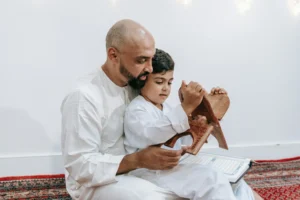
The foundation of Qur’anic tarbiyyah begins with parents themselves. Children learn
far more from what they observe than from what they are told. A home cannot
become Qur’anic if the Qur’an is absent from the lives of its adults. When children
see their parents turning to the Qur’an for comfort during hardship, for guidance
during confusion, and for gratitude during blessings, they begin to understand its
living relevance.
One of the greatest misconceptions about Islamic parenting is the belief that
religious upbringing is primarily the responsibility of schools, teachers, or weekend
classes. While these institutions play an important role, Allah has entrusted parents
with the first and most influential responsibility. The home is a child’s first school, and
parents are their first teachers.
The Qur’an itself presents us with beautiful examples of parental tarbiyyah. Among
the most profound is the advice of Luqman to his son. His guidance begins with faith,
teaching his child to recognize and worship Allah alone. He then moves to gratitude,
prayer, character, humility, patience, and social conduct. This sequence is
remarkable because it reminds us that true tarbiyyah is holistic. It develops both
belief and behaviour, both worship and character.
A Qur’anic home is not necessarily a perfect home. It is a home that continually
returns to Allah. Mistakes will happen. Voices may sometimes be raised. Routines
may occasionally break down. Yet a Qur’anic home is distinguished by repentance,
forgiveness, mercy, and the sincere effort to improve.
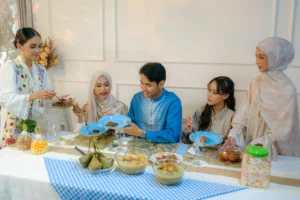
One practical way to build such a home is to establish a daily relationship with the
Qur’an, even if brief. A few verses recited together after Fajr, a short reflection after
Maghrib, or discussing one Qur’anic lesson at the dinner table can have a profound
impact over time. Consistency often transforms hearts more effectively than
occasional bursts of enthusiasm.
Another important aspect of Qur’anic tarbiyyah is connecting children to the
meanings of the Qur’an. Many children learn to recite beautifully but struggle to
understand how the Qur’an relates to their daily lives. Parents can bridge this gap by
discussing Qur’anic stories, exploring Allah’s names and attributes, and helping
children see Qur’anic principles reflected in everyday situations. When a child shows
kindness, parents can connect it to Allah’s love for those who do good. When they
face disappointment, parents can remind them of patience and trust in Allah.
The atmosphere of the home also matters. The Qur’an nurtures tranquillity, mercy,
and remembrance of Allah. Homes filled with constant anger, criticism, and negativity
can make faith feel burdensome. By contrast, homes where gratitude, gentleness,
and dhikr are common create fertile ground for spiritual growth.
Importantly, Qur’anic tarbiyyah is not measured by how much a child memorizes
alone. Memorization is a blessing, but the ultimate goal is transformation. A child
who learns honesty, compassion, humility, and reliance upon Allah through the
Qur’an has achieved something far greater than the ability to recite verses without
understanding them.
Parents should also remember that guidance ultimately belongs to Allah. Our role is
to plant seeds, nurture them with love and wisdom, and trust Allah with the results.
Even the Prophets could not guarantee guidance for every person they loved. What
is required from us is sincere effort, consistency, and heartfelt dua.
Perhaps the greatest legacy parents can leave behind is not wealth, status, or
worldly success, but children whose hearts remain connected to Allah and His Book.
Such a legacy benefits families long after parents have departed this world.
Building a Qur’anic home does not happen overnight. It is built verse by verse,
prayer by prayer, conversation by conversation. It grows through sincere worship,
loving guidance, and reliance upon Allah. Over time, the Qur’an moves from the shelf
into the heart, and from the heart into the culture of the home.
When that happens, the Qur’an is no longer merely read within the house—it begins
to live within it.